This morning, when I went to the bank to pay my credit card bill, I saw the latest prices for gasoline in Panama City, Panama (Central America). Prices are reaching the stratosphere: Panamanians are buying smaller cars, motorcycles and scooters to make ends meet. Even traffic cops are using Korean scooters in an attempt to reduce their operating expenses. The good thing about gasoline high prices is that it’s a strong incentive for more fuel-efficient vehicles. Electric or hybrid cars are excellent alternatives. Toyota is spending millions of dollars in R&D to manufacture these types of cars—Prius 08. U.S. engineers are also burning the midnight oil in an effort to compete with Japanese or Korean high-mileage automobiles. A good example is the Aptera Typ-1 manufactured by Aptera Motors (formerly Accelerated Composites). Aptera Motors is a maker of high-efficiency vehicles based in San Diego, California. Aptera’s first product, a three-wheeled two-seater named the Typ-1, is currently under development, though they are accepting pre-orders from California residents. The Typ-1 claims a fuel efficiency of 300 mpg at 55 mph making it one of the most fuel-efficient cars in the world. On several experimental tests,Aptera’s engineers have been able to get 340 mpg and expelled only 78 grams of greenhouse gases. You can’t beat this with a stick. Aptera Motors claims acceleration from 0–60 mph in less than 10 seconds with a top speed over 85 mph. They have set the price at $26 900 for the all-electricAptera Local , and $29 900 for the plug-in hybrid Aptera Everywhere. The Aptera is a good example of how high gas prices are encouraging entrepreneurs to give the car business a try. From electric high-performance roadsters to low-speed runabouts, start-ups are trying to take advantage of interest in alternative technologies. This concept car of the future has a unique design. The prototype features high-tech touches such as rear and side cameras instead of rear-view side mirrors to further reduce wind drag. There’s a solar panel on the roof to provide a bit of extra power. Making the car out of laminates slashes its weight to about 1,500 pounds, making it potentially one of the lightest cars on the road. Less weight means longer range. The company also hopes to use off-the-shelf lithium phosphate batteries that are proven and safe. Even though there is a lot of work left to be done, Aptera has an advantage when it comes to development time. The three-wheel design—two in front, one in back—means the resulting vehicle will be classified as a motorcycle in many states, including California. The testing and red tape required to market a motorcycle is less rigorous than for a four-wheel car. This means less time to leapfrog the competition. Before production starts, managers are being issued copies of books detailing how Toyota cuts waste and encourages quality on assembly lines. The goal is to produce two or three cars a week once production begins. The company expects to become profitable once production hits 160 vehicles. This video from YouTube provides an excellent description of Aptera’s test drive.I’m already writing my Santa Claus letter way ahead of time. 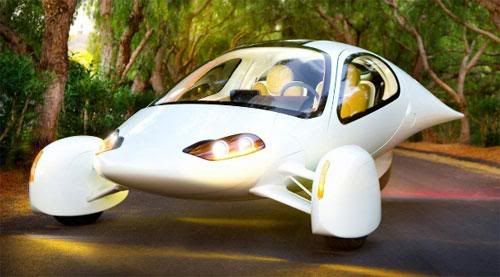

This entry was posted
on 01:01
and is filed under
Future
.

 Chinese
 French
 German
 Italian
 Japanese
 Korean
 Russian
 Spanish
